
Feature
Are UK Railways Prepared to Adapt for a Changing Climate?
 Callum FrazerRolling Stock & Freight Reporter29 August 2026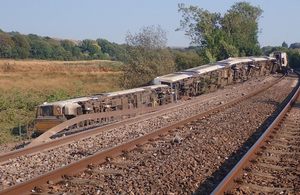
After one of the hottest and driest summers on record, with drought declared across large swathes of the country, a major question now looms over Britain’s railway network: how prepared is it for a changing climate?
With an El Niño event developing, the UK has been warned to brace for another potentially challenging summer next year, with the Met Office forecasting that further temperature records could be broken.
Britain’s railway system is already under unprecedented pressure, with services disrupted by widespread cancellations and delays and, in more extreme cases, trains being derailed.
Commuters have faced constant disruption whilst heading into the office, and timetables have been reduced as well as the speed at which trains were able to travel.
Shockingly , two trains were derailed in the space of 24 hours resulting in several casualties and pressure on the emergency services who responded to the incident.
As a result of this, two people were taken to major trauma centres with severe injuries.
Now ,Network Rail is calling for extra funding that could be needed in the future to help rail services cope with the ongoing impacts of climate change and more severe weather patterns.
Martin Frobisher , the Group Safety and Engineering Director for Network Rail told BBC Radio 4’s Today programme “we don’t know yet the full facts and reasons for those derailments but a very detailed investigation is under way and we’ll be getting to the bottom of it , and clearly we will be looking at climate and all sorts of other issues as factors”.
According to Network Rail, extreme heat has already presented significant challenges for the railway, affecting electrical signalling equipment and increasing the risk of tracks buckling.
In some areas, ground temperatures have soared above 50°C, placing further strain on critical rail infrastructure.
Network Rail stated that the fifth heatwave of the year had “presented exceptional challenges to the railway” and urged passengers to plan their commutes carefully and avoid travelling if they could.
In 2024 Network Rail was forced to increase their projected five year spending on climate by five times the amount allocated from 2019.
Professor Adam Scaife , the Met Office’s head of long range forecasting said the scale of the growing ‘El Nino’ is “unprecedented” with pacific sea temperatures expected to reach as high as 3 degrees and potentially more.
He also went on to say that rail operators must prepare for 2027 to be potentially worse than 2026 in terms of experiencing periods of record breaking heat that will cause disruption to public transport and railways.
So what happens to railways in periods of extreme heat ?
As temperatures rise, steel tracks expand.
However, because railway tracks are typically laid as continuous lengths of steel, there is limited room for that expansion to be accommodated.
As temperatures rise, the pressure within the rails increases, causing the steel to deform and, in extreme conditions, buckle.
When long, continuously welded sections of track buckle, the consequences can be serious, posing a significant risk to the safety and reliability of rail services.
On a hot day ground temperatures and rail temperatures in particular can reach much higher temperatures than air.
The weight and vibration of passing trains can further exacerbate the problem, placing additional strain on already weakened, drought-affected ground.
As the surrounding land dries out, the soil and foundations can become increasingly unstable, potentially causing uneven settlement beneath the tracks.
And whilst tracks and stations have been updated over the years, some embankments, tunnels and other structures date back to as early as the 1800s when much of the rail network was first laid.
Network Rail said it is fully committed to supporting the continuing investigation into the incidents that took place in Lewes, East Sussex and Wickford in Essex and acting on any lessons that emerge from its findings.
A Statement from Network Rail that was released stated ;“Safety is and will always remain our highest priority. While Britain’s railway is one of the safest in the world, when incidents like this occur it is essential that we understand exactly what happened and identify any lessons that can be learned.”
About the author
Callum Frazer
Callum covers fleet procurement, depots, traction and the rail freight market. (Sample profile.)
More from this authorMore from Sustainability
Decarbonisation plan hinges on unglamorous infill schemes
Analysis suggests traction decarbonisation targets depend less on headline electrification and more on a long tail of short, low-profile infill schemes.
Marcus Aldridge · 11 Aug 2026 · 6 min read