
News
Lewes derailment raises wider questions over the resilience of Britain’s railway
As investigators examine the causes of the Lewes derailment, the incident has renewed attention on how Britain’s rail infrastructure is monitored, maintained and prepared for increasingly challenging conditions.
 Sarah EnwrightBusiness Editor31 August 2026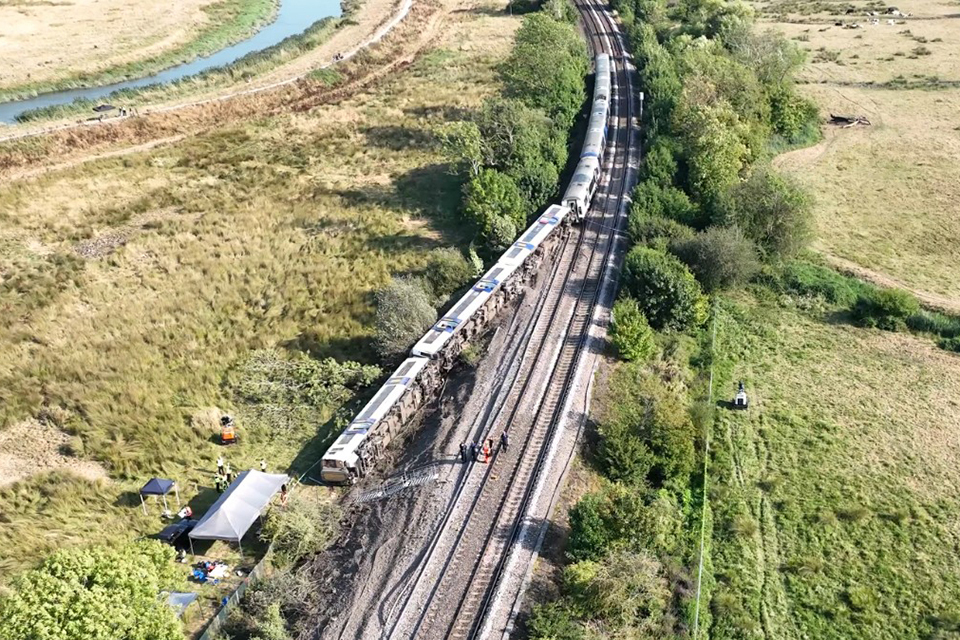
The derailment of a Southern passenger train near Lewes has placed renewed attention on the condition and resilience of Britain’s railway infrastructure, as investigators examine the track, embankment and weather conditions surrounding the incident.
The train, which was travelling from London Victoria to Eastbourne, derailed at around 3:54pm on 13 August on the East Coastway line, approximately one mile north of Lewes station.
The eight-carriage train was carrying around 150 people when the rear three vehicles derailed and overturned on the railway embankment.
Thirty people were injured, with 20 requiring hospital treatment, while significant damage was caused to both the train and the surrounding railway infrastructure.
The incident has since resulted in a major recovery and repair operation, whilst the Rail Accident Investigation Branch (RAIB) continues its investigation into what caused the derailment.
But what happened to the track before the train left the rails?
What caused the derailment?
Whilst the full cause of the incident has not yet been established, initial findings from RAIB have identified a track geometry irregularity on the approach to the point of derailment.
Forward-facing CCTV from the train involved, alongside footage from other trains operating through the area, showed that the irregularity was present before the accident.
There was also evidence of previous maintenance activity at the location, whilst RAIB received reports from passengers describing rough riding at the site on other services.
However, investigators have not yet concluded that the track irregularity was solely responsible for the derailment.
The investigation is examining a number of different factors, including the condition of the track, the surrounding embankment, the weather conditions before and during the incident and the effectiveness of measures designed to manage risks associated with hot weather.
So could the weather have played a role?
The impact of extreme weather
The derailment occurred during a period of prolonged hot and dry weather across parts of the UK.
At the time of the incident, the nearest weather station recorded an air temperature of around 27°C.
Whilst this may not appear particularly extreme compared with temperatures experienced elsewhere, conditions affecting railway infrastructure can be considerably different from the temperature recorded in the air.
Rail temperatures can rise significantly above ambient temperatures, whilst prolonged periods of dry weather can also affect the ground supporting railway infrastructure.
The railway at the location of the derailment runs across an embankment constructed from clay and alluvial deposits.
These types of ground can be affected by changes in moisture levels, potentially resulting in movement or changes in the condition of the ground supporting the railway.
RAIB has said there is currently no evidence that a significant embankment slip occurred immediately before the derailment.
However, investigators have identified evidence that movement had taken place previously.
This raises a wider question for the industry: how can railway infrastructure be effectively monitored when several different risks occur at the same time?
The challenge for Network Rail is not simply maintaining the track itself.
Railway infrastructure is made up of interconnected systems, meaning the condition of the track, earthworks, drainage, signalling and surrounding structures can all have an impact on the reliability and safety of a route.
And whilst modern monitoring and inspection techniques have improved significantly, much of Britain's railway infrastructure was constructed decades, and in some cases centuries, ago.
A major recovery operation
Following the derailment, Network Rail engineers began work to recover the damaged train and restore the railway.
The location itself presented a number of challenges, with the railway running close to the River Ouse and specialist equipment required to safely remove the derailed vehicles.
Temporary foundations and working platforms were constructed to support heavy lifting equipment and specialist cranes.
Engineers have also been required to replace damaged track, repair signalling equipment and rebuild sections of the railway embankment.
So when will services return to normal?
Network Rail and Southern have been working towards reopening the line between Haywards Heath and Lewes on 1 September, subject to the completion of the recovery and repair programme and the necessary safety inspections.
By 26 August, Network Rail reported that more than 80% of the work required to restore the railway had been completed.
Before trains can return, the infrastructure must undergo further testing and inspection to ensure that the railway is safe and reliable for passengers.
For the supply chain and engineering teams involved, the recovery demonstrates how quickly a single incident can require work across several areas of railway infrastructure.
It is not simply a case of replacing a section of damaged rail.
Track, signalling, earthworks and access arrangements all have to be considered before services can safely resume.
What does this mean for the wider industry?
The immediate priority remains the safe reopening of the railway and supporting passengers affected by the disruption.
However, the longer-term implications could be more significant.
The RAIB investigation will examine the exact mechanism of the derailment, the condition and maintenance of the track and embankment, the weather conditions in the period leading up to the incident and the effectiveness of measures intended to manage hot-weather risks.
It will also examine the condition of the train and the performance of the rear three vehicles during the derailment.
Could the findings therefore lead to changes elsewhere across the network?
That will depend on the conclusions of the investigation.
If issues are identified around track monitoring, maintenance, earthworks or the management of extreme weather, the lessons could extend beyond the immediate location at Lewes.
Britain's railway is already under pressure to improve reliability whilst maintaining a network that carries millions of passengers and tonnes of freight every year.
At the same time, infrastructure managers are having to consider how existing assets will perform under increasingly challenging conditions.
For Network Rail and its supply chain, the question is therefore not simply how quickly a damaged railway can be repaired.
It is whether the industry can identify potential weaknesses before they become incidents, and whether existing inspection, maintenance and resilience measures are sufficient for the conditions the railway will face in the future.
What happens next?
The investigation into the Lewes derailment remains ongoing, and the final findings are likely to provide a much clearer picture of what happened and why.
For now, engineers remain focused on restoring the railway and ensuring that the route can reopen safely.
But once services return, the industry will still be left with a number of questions.
How can track and embankment conditions be monitored more effectively?
Are existing measures sufficient to manage prolonged periods of hot and dry weather?
And, as Britain's railway continues to operate an ageing and heavily used infrastructure network, what further investment will be required to ensure that it remains safe, reliable and resilient?
Those are questions that will extend well beyond Lewes.
About the author
Sarah Enwright
Sarah reports on contracts, investment and the commercial shape of the UK rail supply chain. (Sample profile.)
More from this authorMore from Infrastructure
Highland resilience works accelerate after third weather closure
Weather-related closures have accelerated a £310m resilience programme, with earthworks stabilisation and drainage renewal brought forward on a strategic route.
Marcus Aldridge · 15 Aug 2026 · 4 min read